Omega De Ville Chronograph Co-Axial Calibre 9300/9301


It’s the horological equivalent of a rags to riches story. From very humble beginnings as a line of blue collar, entry-level watches promoted in the early 1960s by Omega’s US agent, Norman Morris, the Omega De Ville collection has risen steadily in status to rival most of its siblings in the Omega and other high-value brand stables.   It is fitting that the new in-house calibre 9300 and 9301 movements (depending on the depth of your pockets) will purr under a De Ville dial.

The De Ville 18-carat red gold chronograph is classic ‘Veblen’ merchandise and mirrors the ‘riches’ accumulated by anyone able to afford the top end of this line. Veblen was coined by economist, Thorstein Bunde, to describe a range of high-end merchandise that is perceived to be exclusive as long as prices remain high or increase. And, priced at around 29,000 US dollars, the De Ville solid red gold chronograph satisfies most, if not all, criteria for a bona fide Veblen object: it’s pricey; it will be produced in comparatively fewer numbers; it houses some exciting twenty-first century micro-mechanics; it has classic styling and it looks ‘expensive’.   

Rolex have appreciated the Veblen effect for decades, churning out millions of watches with robust, albeit ugly-looking movements priced at the retail end from 6,000 to 10,000 US dollars (much more these days) and costing a fraction of that price to produce. The good thing about the De Ville 18k chronograph is that while huge margins are built into the price it is far, far from ugly - on the inside or the out.

If you don’t have the spare change to land the red gold version of this 42mm heavyweight, then the stainless version – either with strap or stainless steel bracelet - may suit your budget at around the 8300 to 9000 USD mark.  Still Veblen, but at least there will be some funds left over in the kids’ college accounts that could be designated for their original purpose!

The styling of this piece defers to watch design of the nineteen-twenties to forties: big, plump, polished and brushed case body, and rounded lugs with a long curve, giving an organic, Art Nouveau quality to the overall design. Roman numeral markers on the dial add a touch of classicism, and simple, tapered and faceted gold hands and understated sub-dials preserve the subtlety of this prestige piece.  A number of dial combinations in black, silver and blue are available, depending on the model you choose.

All of the expected hallmarks of a dress chronograph are present: twenty-first century two sub-dial movement with silicon balance and tri-level co-axial escapement with some of the best performance and stability numbers in the business; column wheel chronograph mechanism visible through three cut-outs on the bridge; exquisite cosmetic and functional finish of the plates, rotor and bridges; blackened screws, barrel and balance wheel to add a bit more colour contrast, and an exhibition case back to remind you of what you are getting for your money. The 18 carat gold version offers an 18 carat gold rotor and balance bridge, with the stainless model featuring a rhodium-plated rotor and balance bridge. A further feature of the piece is the ability to change the hour hand without affecting the minute hand and sweep.

While the De Ville dress chronograph speaks the Veblen lingo eloquently, it is one of the best, if not the best, in its class.

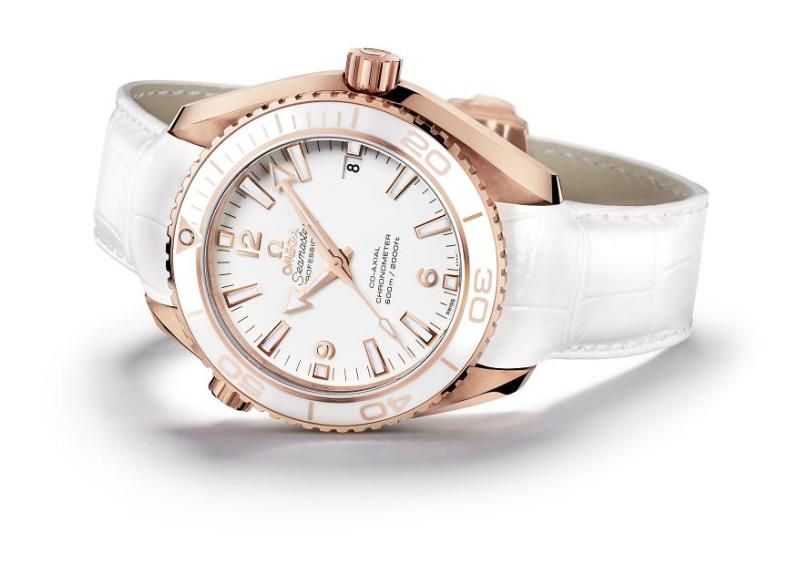
OMEGA Seamaster Planet Ocean Ceragold™ Collection


Bezels are probably more prone to accidental damage than any other part of a professional dive watch, and the Swiss watch industry has devoted a king’s ransom in research and development money to further the quest to make them more robust.  The use of ceramics, hard metal innovation, and more recently Omega’s introduction of liquid metal technology are testament to the pursuit of the indestructible bezel. 

With the introduction of liquid metal versions on some Seamaster Planet Ocean editions, Omega is a little further along to track to the ultimate bezel than its major competitors. Liquid metal set the standard for professional dive watches, and Omega’s new offering, Ceragold, may well set it for those who like to keep their head well above water. As with liquid metal bezels, Omega has pioneered a new method for forming the metal diving scale. It involves a complicated series of manufacturing steps, described here on the Omega website.

The Ceragold method has the potential (if the Omega design shop has its wits about it) to be applied to a range of innovative and exciting applications. Imagine a ceramic Omega dial with Ceragold markers and Omega logo, or elegant dial designs etched into ceramic and complimented with gold filling using the Ceragold method; consider the use of Ceragold as an elegant ornamentation technique on bezels other than dive watches; contemplate Ceragold and ceramic bracelet inserts and clasps, or case back medallions. The ceramic colour and applications of Ceragold are only limited by the imagination, and here’s hoping that we see some original and inventive applications of Ceragold at future Baselworlds. 


The new Seamaster Planet Ocean Ceragold collection is designed but not meant for subaqueous environments. With prices ranging from 22,500 to 33,000 USD for these eighteen-carat gold beauties, you should not expect to see one on the wrist of a navy diver. Rather, they will find their homes in more elevated, rarefied milieus probably well above the twentieth floor.

Do not despair, however, because the professional dive features can be used in other, more creative ways. Rather than indicating elapsed diving time, the bezel of Ceragold 42 mm White Planet St. Moritz, for example, is an excellent device to check elapsed time of your high-level presentations, or to ensure your parking meter doesn’t run out. You can set a specific and acceptable duration for ducking into the executive toilet to smoke a joint, or check elapsed waiting time at your favourite restaurant.  Same thing with the 45.50 mm eighteen-carat red gold Planet Ocean Chronograph powered by the calibre 9301 (Click here for a Watchtime review of the SS Cal 9300 PO).  The helium escape valves may come in handy as metaphorical self-management tools if the pressure gets too much during power meetings or boardroom disagreements!


These luxury models are powered by Omega’s in-house calibre 8501 and 9301 movements, both of which have a matching eighteen-carat rotor that is visible through the exhibition case back. Undoubtedly they are beautiful pieces, the St Moritz conforming to the standards of a jewellery watch, and while their market will be limited, it’s nice to see them as examples of innovation in watch materials.

Speedmaster “First Omega in Space” Numbered Edition Chronograph


While there have already been comments bewailing the fact that the Speedmaster “First Omega in Space” fiftieth anniversary numbered edition is not the size of the Speedmaster Professional, perhaps said commentators may be somewhat mollified when they consider the unparalleled value offered  by this commemorative piece. Besides, it is appropriate that a watch that honours Wally Schirra’s choice - two years and five months prior to NASA officially adopting the Speedmaster -  to give his CK 2998 Speedmaster some wrist time aboard the Mercury Atlas mission of 1962 is sized as its contemporaries were. 

Of the Speedmaster offerings at Baselworld, this is the purists version. The other two, notwithstanding the allure of the Z – 33, can be seen as ‘monetisations’ of the Speedmaster’s incredible brand power.  Tracing its genotype back to the classic calibre 321 that powered Schirra’s original Speedie, the calibre 1861 under the bonnet offers authenticity and great value for money for the USD 5,300.00 price tag. 

The hand-wound calibre 1861 is still one of the smallest chronograph movements on the market and this allows a nice comfortable case height of 14mm in the Schirra Speedie. The case aesthetics are of the later period and feature the familiar faceted lugs.  The 1861 is fundamentally the same calibre as that designed by Lemania’s Albert Piguet in 1942. The main differences between its early predecessors are that of a column wheel having been replaced by a cam, a steel braking lever replaced by a more shock-resistant Delrin lever and a change of balance and beat rate.  For a chronograph movement to have been around for seventy years with so few modifications is a testament to the brilliance and execution of its design. 
      
The classic ‘white on black’ lacquered dial, originally inspired by the instruments on Italian cars of the period, together with the Alpha hands provides superb readability.  The hour markers and hour and minute hands are coated with super luminova.  Unlike the original, the Schirra commemorative Speedmaster has a sapphire crystal to better protect the dial from the bumps and grinds of contemporary life.

As a numbered edition, special attention has been paid to the screw-in caseback.  The Seahorse medallion (the Speedmaster was conceived as part of the Seamaster collection) is deeply embossed, and around the perimeter of the medallion in raised lettering are the words “THE FIRST OMEGA IN SPACE” and “OCTOBER 3, 1962”, The numbering is etched on the case back rim.  The watch comes with a brown stitched leather strap.

There are many reports of the how’s and whys of NASA choosing the Speedmaster as the official NASA mission watch, and it behooves any proud owner of a ‘real’ Speedie to know the history of the marque. A good write-up on the NASA evaluation and testing process can be found here.  A fuller history of this iconic brand can be found here. From the inception of the concept, Omega’s design chief, Pierre Moinat, wanted the Speedie to both stand out from the crowd and appear the natural choice for a motoring chronograph. He succeeded on both counts, and Omega is not boasting when it states that the Speedmaster is the “world’s definitive chronograph”.   

The Schirra commemorative Speedmaster will be available after September 2012

Basel-world 2012: The Omega Spacemaster Z-33


Ever since Omega somewhat belatedly patented its ‘Ligne Pilote’ case design in November 2010, watch aficionados knew something was up. Informed speculation leaned towards an upgraded X33 sitting in a pilot line case.....and it was right. 

Featuring a freshly minted calibre 5566 quartz movement, the Z-33 offers analogue time-telling adjustable at the crown and a range of digital functions that will be very useful to pilots - even in these days of iPads and digital paraphernalia that allow pilots to do practically everything, except perhaps have sex with their chief stewardesses. Functions include Coordinated Universal Time (UTC) and two other time zones, also allowing owners to cross the international date line and accommodate forward and regressive date changes.  The chronograph function of the movement can measure elapsed time from destination, and ten separate flights can be logged and represented visually

With four pushers and a crown, the Spacemaster Z-33 is a complicated piece of kit. If you have problems programming digital recorders or setting up a new television set, this will really flummox you. But, with a little practice and a certified membership from MENSA, you should get the hang of it! 

The design is pure brutalism with a dark side that will appeal to anyone who nurtures and enjoys their Jungian shadow. The classic titanium pilot line case, a derivative of the Flightmaster cases of the late nineteen-sixties and early seventies,  features a deep linear adoucissage finish that radiates from the centre point of the watch and you can almost cut yourself, or others, with the sharpness of the perimeter edges. The 19.3 mm case is much thicker than the earlier Flightmaster cases and overall measurements are a whopping 43mm by 53mm.  

The dial is simplicity itself. A deep charcoal ground is highlighted with white superluminova indices with the outer ring featuring the classic Flightmaster five-minute configuration. Two mirror image digital displays with black backgrounds pulse out red characters.  Dagger hands, also coated in superluminova are skeletonised to allow better visibility of the digital displays.

A choice of rubber or leather straps is offered, but the rubber strap with the red outlines, in my opinion, completes the implicit ‘menace’ of the design story.  This is the ultimate electro-mechanical tool watch, and it may well become a cult piece just as the Omega X-33 has.  Available only from Omega boutiques, the Z-33 will set you back around USD 5900.00 and will be available from May, 2012.

Oh, and for those who may have described, or will describe, this wonderful piece of ordinance as “fugly’, I simply ask, have you looked at yourself in the mirror lately?

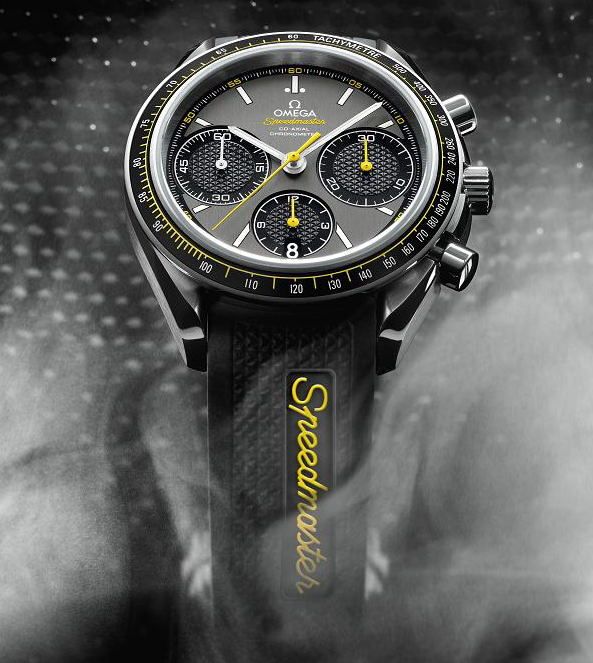
Omega Speedmaster Racing Chronograph


I’m not going to say much about this 40mm, $4800.00 entry-level Speedmaster, save that it looks racy, sporty, fun and is generally a nice piece of design. It will certainly hook in the neophytes and those who don’t know their Speedmasters from their Mixmasters.  

Said to honour the Speedmaster’s original purpose, that of a companion to well heeled petrol-heads who were into car racing, this new "Racing" Speedie comes with a choice of dial colour combinations including maroon and blue, and you may pick between a standard bracelet or black rubberised band with colour outlines. 


The subdials are finished in what is described as a “Clous de Paris” pattern. Clou is a French word used colloquially to refer to carbuncles and boils, and also to nails and other forms of fastening. I suspect the Omega marketing department had in mind one of the latter definitions, as I can’t imagine they would have us view the subdials as being finished in the manner of a Parisian carbuncle.


It’s what under the bonnet that doesn’t impress me at all.  Hyperbole for effect, but if you’re looking for a movement that needs to be tucked into bed and told a story every night just to keep it happy, then maybe this model is for you.  If you want a Real Man’s Speedmaster, then you have only one movement choice, the bulletproof calibre 1861.

I thought Omega was going to consign the effete Piguette-based chronograph movements to its women’s collection, and to see a calibre 3330 under the Speedmaster appellation is a tad disappointing. Why not a worked up calibre 1164 based on the famous Valjoux 7750 ‘tracteur’?  At least it would stand up to the kind of bullying to which men’s watches are often subjected.  

You'll have to wait until November before this collection reaches Omega boutiques and retailers.  

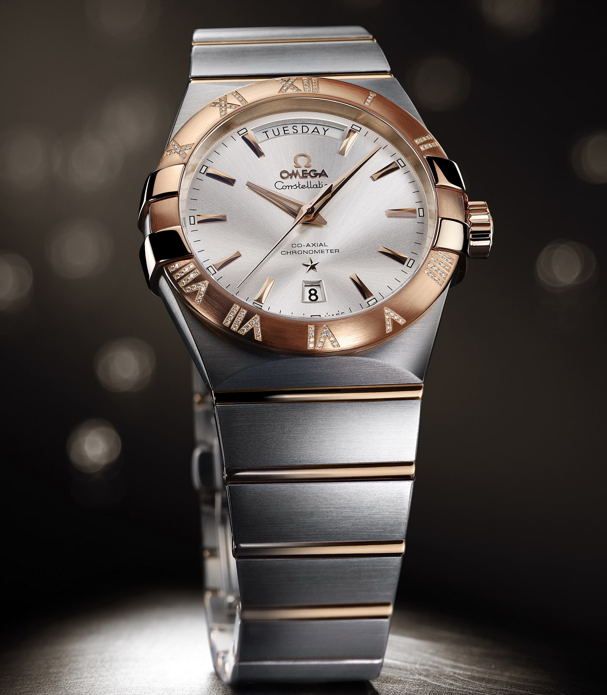
Omega Day-Date Thirtieth Anniversary Constellation


The Constellation Day-Date has been a long time returning. The last fully in-house Constellation movement with the day-date complication was the calibre 1021, phased out in 1979. 

Between now and July, Omega will release various iterations of the 38 mm case Day-Date Constellation, starting with diamond bezel models that will set you back between thirteen and thirty-eight thousand dollars and culminating in the release of the all stainless model with black dial in July, priced at around $8300 US Dollars. I say “culminating” because I think the black dialled all stainless Day-Date is a classic in the making. 

Under the dial is a modified calibre 8500 movement which Omega has designated as the calibre 8602 to identify the Date-Date complication.  This family of ‘in-house’ co-axial calibres now has five years of history behind it; five years in which no major design or manufacturing fault has surfaced,  a truly remarkable track record for a new calibre.  Featuring a silicon balance and co-axial escapement, the series is one of the most beautiful looking new millennium movements on the market.

The Constellation Day-Date arrived at Baselworld 2012, thirty years after Carol Didisheim’s first Manhattan version with the famous griffes (or claws) created a sensation at Baselworld in 1982. (Click here for the story of how the griffes came about).  I’m surprised that Omega has not made more of the Didisheim link to today’s Constellations and  acknowledged her contribution to one of the most enduring designs in contemporary Swiss watchmaking. 

There is a remarkable balance to the dial design that respects the minimalist approach to Constellation dials. The curved day aperture is tucked neatly between the eleven and one o’clock markers and the date aperture unobtrusively replaces the six o’clock marker.   

While most men will eschew bezels that have the numerals set with 116 full-cut diamonds (seen in the picture above),  a wait of a mere four months will net you a silvered or black dialled version of this classic thirty-nine jewel chronometer. 

Omega’s First Baselworld Release – Seamaster Aqua Terra GMT


At last! ....an Omega Aqua Terra GMT powered by one of Omega’s new generation movements.  The most recent AT GMT on offer was the chronograph version powered by the Piguet-Based calibre 3603, and while it had the looks, some argued that it didn't have the right movement at its heart. To be officially released during Baselworld 2012 in a matter of weeks, this AT GMT has both: aesthetics uninterrupted by chronograph sub-dials and a GMT modification built on to Omega’s exclusive calibre 8500 series of co-axials.  Designated as the Omega Co-Axial series 8605/8615 this is the first of OMEGA’s exclusive ‘in-house’ movements to carry the GMT complication. The movement is equipped with a silicon balance spring and Omega’s confident four-year warranty applies.

I have waxed lyrical on the ATs dial and case design in earlier reviews, so you will not have to endure any lapse into purple prose here, save to reiterate that a GMT complication on a clean dial is so much easier on the eyes than such complications on chronographs – no fairground busy-ness here, just outer and inner chapter rings in complete harmony with the circularity of the dial and the date aperture subtly placed at six o’clock. The GMT register is tucked neatly into the ambit of the applied markers and the GMT hand, marginally longer than the hour hand, is outlined in red to make its twenty-four hour rotation visible but not over-powering. The red touches on the dark teak dial and GMT hand add just the right measure of sportiness to this piece without limiting the occasions on which the watch can be worn.

All dial furniture is either 18k white or red gold, depending on the case metal chosen, and the hands and indices are coated with white Super-Luminova. At 43mm, it’s a big watch and I would have liked to have seen this 2012 offering measure in at around 39 to 40mm, the size of the new Certina DSI release at Baselworld this year. Non-Chronograph case sizes, in general, diminished last year at Baselworld and it will be interesting to see what the trend is in 2012.  Ultra thin watches are also making a comeback (check out the new Rado Thin-Line range) and while clunk and chunk will no doubt still reign supreme, keep an eye out for what the cutting edge and style-meisters of watch design are doing.

The AT GMT will be available in Stainless Steel, red gold or two-tone models and can be accessorised by matching bracelets or a choice of black, brown or blue leather straps. Expect the price of the Stainless version to hover around the USD 8,500 mark.

Omega Speedmaster Moonwatch Chronograph Co-Axial calibre 9301


The Omega Speedmaster family is one of the most visible watch collections in the world. While the early antecedents were great space travellers and accompanied NASA astronauts on their momentous space missions of the late nineteen-sixties and seventies, some of the more recent progeny that haven’t carried the authentic moonwatch gene have, in my opinion, let their illustrious fore-fathers and mothers down.  I’m pleased to say that the new Speedmaster Co-Axial calibre 9301 model is not one of them.

For purists, the only Speedmasters worth embellishing the wrist are those that are linear descendents of the moon watch (the calibre 321/861/1861 progression), and such tastes are amply catered for with the limited edition Apollo 15 Anniversary model and the Speedmaster Professional range. But, for those who hankered for an automatic version that still offered some historical rub-off, the most recent options have been limited to models powered by the somewhat effete Piguet-based 33xx and 36xx calibres. The exception was the more strapping 3212.80.00 calibre1164 date range based on the famous Valjoux 7750 ‘tracteur, but that was superceded by the sissier calibre 3304 versions.


The Omega Speedmaster Moonwatch Chronograph Co-Axial calibre 9301 (seen above in the 18k orange gold iteration) adds muscle back into the automatic collection with a new in-house automatic movement that was designed from the bottom plate up for robustness and accuracy. This collection pays due homage to the famous design elements of the Professional – classic black dial, tachymeter and original hands – and blows the size of the watch out to a weapons-grade 44.25 mm.  Not for the faint-hearted and likely to cause a back injury to anyone weighing less than 170 pounds, this piece is meant to be worn with a swagger.

Perhaps a fat wallet lodged in the right-hand back pocket will help owners of this new Super-Speedie maintain vertical equilibrium, because they will certainly need a sizeable stash to pay the $35,000.00 plus for the platinum version. The more reasonably priced stainless steel version will still dent the pocketbook at $7,000 dollars plus, with the ‘orange’ gold version priced in the middle.

So, what are you getting for your money?  The answer is that you’re paying for twenty-first century movement that is one of the most technologically advanced machines currently in production: co-axial escapement, free-sprung balance, innovative column wheel and vertical clutch arrangement, silicon balance spring, new-age materials in some of the components, novel two subdial chronograph configuration, beautifully executed case, an upgraded bracelet that allows better adjustment when links are removed, a four year warranty and a COSC certified chronometer watch that promises to deliver outstanding reliability over a long period of time. 

The Omega Seamaster 1948 Co Axial "London 2012" Limited Edition


The Seamaster 1948 homage caused more than a few ooohs and aaahs amongst Omega devotees at this year's Baselworld watch fair, and, fortunately, for those instant gratificationists who cannot wait for the 2012 opening ceremony and must have one now, this limited edition of nineteen-hundred and forty-eight pieces goes on sale on July 27th 2011. 

The Seamaster 1948 is derivative, rather than an entirely faithful replica, of one of the very first of this line to be released: the calibre 343 RG powered Seamaster chronometer, model 2518.  Seen below, this beefy lugged celebrity is one of the most collectible of the early bullet-proof, “bumper” calibres. And, it is an entirely appropriate choice for the 2012 Olympics, commemorating Omega’s timing of the 1948 London Olympics known as the “Austere Games”. At that time, large parts London were still in ruins; food rationing remained in force, and rubble strewn streets were still a common sight. The 1948 London Olympics was also notable for being the only Olympics where athletes brought their own food and "the Magic Eye", Omega's newly developed photo-finish technology was used for the first time. 


In comparing the two pieces, the similarities, rather than slight differences, in design stories become apparent. The applied Arabic numerals at the quarter hour are almost identical, save for the six o’ clock marker that is not present in the original. The faceted arrowhead markers, again, are reasonably accurate facsimiles, the rounded Lance Alpha hands are true to the originals and the chapter ring is the same. The big difference is the size of the sub-seconds dial and the use of a flat opaline surface in place of the domed silvered dial on the 1948 version.  The seconds sub-dial could not be located lower on the dial because of the 26mm calibre 2202 movement powering this larger commemorative model. However, I would have liked to have seen a replication of the domed dial as it softens the overall styling of the piece.  

The case of the Co-Axial is 39mm in diameter, 5mm larger than the vintage version, and while the wide polished bezel and case middle have been reproduced faithfully, the polished lugs on the new version are marginally more curved. An 18 karat London Olympics medallion replaces the original plain case back. Designed by Wolff Olins, this official logo adds collecting provenance to the piece.


The power plant is, as mentioned above, the exclusive Omega calibre 2202 co-axial. This movement is basically a jewelled-up calibre 2500C with a sub-seconds configuration, a heavily modified version of the ETA calibre 2982. It has appeared in previous museum homage watches such as the Omega Centenary limited edition piece and also provides the power for the De Ville Prestige collection.  Featuring a three-level co-axial escapement and breguet overcoil balance, the movement offers a power reserve of around 48 hours and is chronometer certified.


So, does the 48 Co-Axial stand as a worthy successor to previous Seamaster Olympic commemorative watches? I think so. Its classic design certainly stirred the passions of collectors at Baselworld, and while I would have rather seen it come with a domed dial, it needs to be remembered that the watch is a contemporary take on an old favourite. Priced at around $USD 5500.00, it is not cheap for a steel cased, 2500-based Omega, however its limited numbers and Olympic associations almost guarantee its future collectability.  On aesthetics alone, I think I would take the plunge. 

Omega Launches the Apollo 15 Speedmaster 40th Anniversary Limited Edition


On the July 26, 2011, at 09:34:00 am, it will be forty years since the Apollo 15 mission blasted into orbit from the Kennedy Space Centre at Cape Canaveral, in Florida. It was touch and go initially because the second stage of the Saturn V rocket ignited prematurely, nearly setting off as catastrophic event where the exhaust of the first stage engine was fed back into the propulsion system.


Also notable was the fact that Apollo 15 was the first of what were described as the “J Missions”, featuring extended stays on the moon for exploration and data collecting. It notched up another first with the moon (rather than world) premiere of the lunar roving vehicle, seen below in the company of lunar module pilot, James Irwin, saluting the US flag - although he could have been waving enthusiastically to his mum back on earth - at the Hadley-Apennine landing site. The mission lasted twelve long days.


The circular mission patch showed a stylised rendering of red, white and blue birds flying over the Hadley-Rille section of the lunar surface, which is adjacent to the Appenines Mountains. Encircled by a blue border, the mission and crew member’s names are printed on a white background against an inner red circle. Fashion designer Emilio Pucci designed the patch, but Commander David Scott and crew chose the colour scheme. 


A new limited edition Omega Speedmaster commemorates this milestone in the US space program of the seventies by incorporating the colour scheme of the Apollo 15 mission patch into its dial design. The minute index is in blue, white and red, replicating the outer circles of the patch. This colour scheme continues with a blue ring around the small seconds subdial, and white and red rings around the 12-hour and 30-minute counters, adding an edge to the otherwise conservative Speedmaster livery.


The case-back identifies its limited edition status and features a nicely executed image of an astronaut hooning about in the lunar rover, echoing many a boy’s fantasy in those days to go dune buggying on the lunar surface. The lunar rover subject on the medallion was chosen to mark the rover's first outing on the moon

The case design is archetypal Moonwatch, with all the customary features that mark the iconology of the Speedmaster design. The case is generously sized at 42mm, but what makes this, and all others of the moonwatch (Speedmaster Professional) ilk, special is the calibre 1861 movement. This classic hand-wind chronograph traces its DNA back to the incredible aviator chronographs produced by Omega in the early 1930s, with its more direct descendants being the calibre 321, designed by Albert Piguet in 1946, and calibre 861, an upgrade introduced in 1968. It is pure horological history on the wrist, and any serious collector of chronographs has at least one.

There have been numerous comments on watch fora about Omega having introduced too many limited edition Speedmasters, but most of that commentary is informed by investment and perhaps exclusivity considerations rather than satisfying a market of collectors who, like in many areas of collecting, want to build limited edition collections and wait eagerly for the next in the series. The Moonwatch limited editions are also created to appeal to the growing number of nostalgists who have developed a renewed interest in memorabilia from America’s pioneering space adventures.

So, is the price tag of around $7000.00 worth the trouble? For lunatics who claim that the US moon missions never took place and harrangue elderly astronauts for being part of the "conspiracy", of course not!  But, I would say yes, particularly for those who like to collect the series, and most certainly for those who wish to have a legend purring away on their wrists.